
Why an async payment platform still needs a strongly consistent ledger
An event-driven payment pipeline is attractive for a good reason: it separates services, absorbs bursts and lets expensive work proceed without holding a user request open. But the financial state at the end of that pipeline cannot be treated like an eventually consistent cache.
Uber's Gulfstream payments platform is a useful example of this boundary. The platform processes most money movement through asynchronous, stateless microservices and Apache Kafka, while preserving a strongly consistent balance for each ledger entity. Uber reports that Gulfstream grew from annualized gross bookings of fifty billion U.S. dollars to two hundred seventeen billion U.S. dollars, moves nearly twice that amount in total money flow, and maintains balances for more than 1.2 billion entities. Gross bookings are not net revenue; they are a measure of the annualized transaction value flowing through the platform.
The relevant design question is not whether a system should be async or consistent. It is which parts may be asynchronous, and where the system must establish a single correct financial state.
The financial model begins with an immutable order
Gulfstream models a real-world commerce event as a Money Order: a set of debit and credit entries between two or more entities. A trip, delivery, freight shipment or stored-value top-up can all produce this generic representation.
The important rule is immutability. After a Money Order is written, it is not updated in place. If a fare changes or an item is missing, the platform writes an additional Money Order that records the adjustment.
This choice avoids a common audit problem. An overwritten record leaves a question: what did the system previously believe, and why did that value change? An additional compensating record preserves both the original decision and the correction. It makes the financial history reviewable without pretending that the first value was never written.
Double-entry is an invariant, not an afterthought
Every Money Order follows double-entry bookkeeping: each credit has an equivalent debit. Uber also runs a pre-commit validation to check that all entries sum to zero. In other words, the order cannot create or destroy money inside the model.
Zero-sum validation is necessary, but it has a limited scope. It proves that the entries balance mathematically. It does not independently prove that every business input, fare rule or payment instruction is correct.
Uber later moved this discipline earlier through Entity Fares. By explicitly recording a fare for each participating entity and enforcing zero-sum at the computation point, malformed structures can be rejected before they reach the payment platform. This is a useful general pattern: enforce an invariant at the earliest layer that has enough information to check it, then validate it again at the financial boundary.
Three data models divide intent, state and history
The platform separates three concerns that are often incorrectly collapsed into one mutable record:
- Money Order models a movement of money.
- Ledger represents a real entity, such as a spender, earner or business, and holds one or more account balances.
- Entity changelog records balance updates in sequence. It provides an audit trail and the facts needed to rebuild a ledger from inception.
In the early design, Uber stored all sub-ledger accounts for one entity in one DynamoDB row. The typical entity was about 1 KB. Keeping an entity's accounts in one row was the mechanism used to protect its balance with strong consistency. Zero-balance sub-accounts were pruned so a long-lived entity would not grow its row indefinitely.
The changelog makes a critical difference. Current balance is necessary for operational decisions, but it is not enough for investigation or recovery. A sequential history makes it possible to reconstruct how that state was reached.
Async outside, strong consistency at the ledger boundary
Gulfstream uses independent stateless microservices for discrete stages such as Money Order creation, processing, collection and disbursement. Apache Kafka is the underlying messaging bus. The Money Order Store and Entity Balance Store are the shared sources of truth across these services, and this asynchronous path processes most of Uber's money traffic.
For flows that happen while a user is waiting, Uber uses Cadence to coordinate synchronous workflows without replacing the async backbone.
This does not mean every part of the pipeline is globally serial. It means that the balance write for the ledger entity must be correct under concurrent updates. A payment system may tolerate an event arriving later at a notification service. It cannot safely tolerate two concurrent mutations leaving the ledger with a balance that neither reflects a valid order nor a valid order sequence.
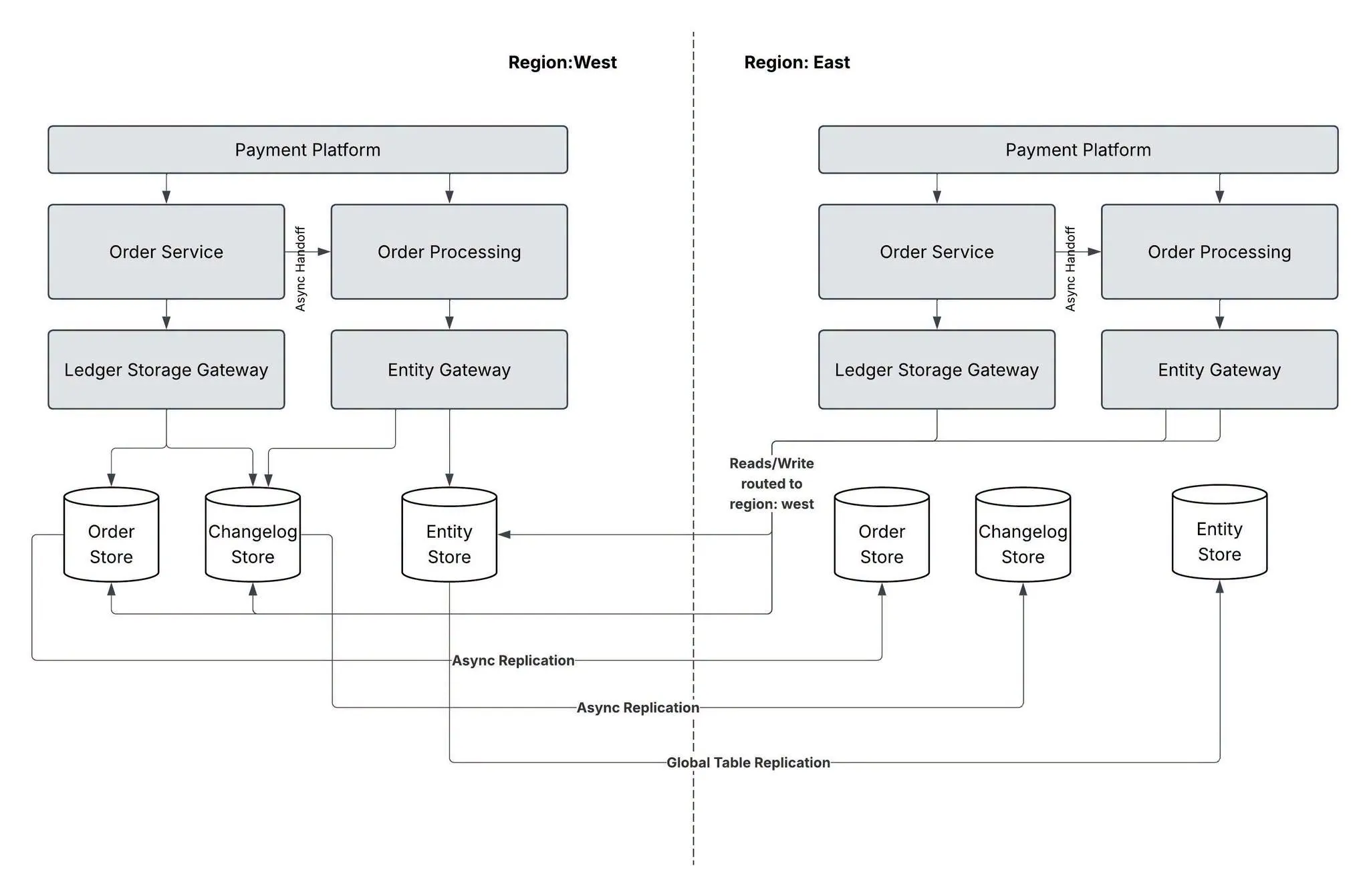
The supplied architecture illustrates the distinction. Both regions can run the payment platform, order service and gateways. Orders and changelogs replicate asynchronously. Entity reads and writes, however, are routed to the West region. That route establishes a single write path for the entity balance instead of allowing competing cross-region writers to independently update the same ledger state.
Hot entities reveal the cost of correctness
Strong consistency becomes difficult when many transactions repeatedly update one entity. Uber calls this the hot entity problem. Growth in Uber for Business and Uber Direct produced entities with concentrated transaction traffic. Serialized writes to one strongly consistent ledger row became a throughput constraint.
Uber introduced a specialized serialized batch-write mechanism and reports a 10x throughput increase for ledger mutations of these high-traffic entities. The scope of that number matters: it describes ledger-mutation throughput for the hot-entity group, not total platform throughput or latency improvement for every payment flow.
The lesson is not to remove serialization. That would weaken the condition that protects the balance. The task is to optimize the serialization mechanism while retaining the order of mutations required by the ledger.
Storage evolved with audit requirements
Uber initially used DynamoDB for orders and changelogs. As audit, regulatory and compliance requirements deepened, the Payments and Storage Platform teams built LedgerStore, a dedicated storage layer for auditability and tamper-evident record-keeping.
This is a reminder that a transactional database selection is not only a throughput decision. Financial systems also need a durable explanation of what happened, an ability to detect unexpected modification, and an operational way to reconstruct state.
Generic abstractions prevent payment logic from fragmenting
Gulfstream deliberately avoids tying core Money Orders to a line of business. Collection, disbursement and refund are platform concepts rather than Rides-only concepts. The same core has been used for new lines such as Freight and Ads with little or no change to payment primitives.
The payment-integration boundary uses generic operations such as charge, disburse and refund. Instrument-specific logic lives in the integration implementation instead of the core platform. This lets cards, local wallets and stored-value products enter through one interface without embedding provider-specific rules into ledger logic.
The same ledger primitives now support stored value such as Uber Cash and B2B billing states including unbilled, billed and settled. Uber describes this as a multi-tenant Ledger-as-a-Service model.
What a backend engineer can carry forward
The Gulfstream case suggests several design checks for a distributed payment system:
- Treat immutable movement records, current balance and history as separate concerns.
- Validate double-entry and zero-sum before committing financial state; push the check upstream where the computation can first prove it.
- Make correction additive. Do not overwrite a historical financial decision merely to make the current state look clean.
- Decide the consistency boundary explicitly. Async replication may be acceptable for history distribution, but concurrent balance mutations need one correct ordering path.
- Expect hot keys. A strongly consistent record can become a throughput bottleneck, so measure and optimize the serialization mechanism rather than quietly weakening correctness.
- Preserve enough ordered history to reconstruct state and support audit.
Uber's article is an architectural overview, not a protocol specification. It does not provide enough detail to conclude ACID properties for the complete pipeline, exactly-once semantics or the algorithm behind serialized batch writes. Those are important implementation questions, but they should not be inferred from a high-level platform description.
Conclusion
Async processing and strong consistency are not opposing architecture styles. They serve different jobs. Asynchronous services keep a large payment platform elastic and loosely coupled. A strongly consistent ledger preserves the one financial state that downstream services, users and auditors must be able to trust.
Gulfstream combines the two by keeping Money Orders immutable, enforcing zero-sum before commit, retaining sequential changelogs, and routing balance mutation through a consistent write path. The result is not “make everything synchronous.” It is a narrower and more useful rule: let the outer pipeline scale asynchronously, but make the ledger boundary strict enough that money never depends on an ambiguous state.
Sources and further reading
- Uber Engineering, Uber's Payments Platform: Scaling Financial Infrastructure (opens in a new tab), August 6, 2026.